Guide 1- You’ve just learned that your brother or sister has cancer
There are no wrong feelings—a guide to self-care.

Save this guide to revisit anytime, no need for internet access or page scrolling
Introduction
Who is this guide for?
This guide is for teen siblings* of children with cancer or other serious illnesses** who want to learn how to start or navigate sensitive conversations about processing the diagnosis at an early stage. If you’re involved in the care or well-being of your sibling with cancer or other serious illnesses—or anticipate you will be in the future—you’re in the right place. We’re here to give you actual, practical tools to help you find your footing, talk about the hard stuff when you’re ready, and process all of this at your own pace.
*Throughout this guide, the term teen siblings refers to siblings, siblings-in-law, cousins, and other extended family members or young caregivers between the ages 13~18.
**While a lot of this guide focuses on cancer, the term “other serious illnesses” refers to any severe, life-changing health condition—including complex chronic diseases, severe genetic disorders, major heart conditions, or sudden traumatic injuries.
About this guide
This guide was developed entirely by Sibling Society. While we’ve made every effort to ensure the information in this guide is accurate and up to date, it should be noted this resource is not a substitute for professional advice. Note that the insights and coping strategies outlined in this guide are grounded in the real, lived experiences of siblings whose brothers or sisters had serious illnesses within their own families. They are intended for peer-support and educational purposes only.
We are always looking to improve our resources to better support our community. Should you have any suggestions, edits, or feedback regarding this guide, please email us at siblingsociety2024@gmail.com
Sibling Society
Founded by a sibling whose younger sister was diagnosed with leukemia, Sibling Society is a registered nonprofit organization in Ontario dedicated to supporting, empowering, and informing siblings of children with cancer, so they can move forward in their changing role with confidence and strength. We provide peer support counseling, mentorship programs, and community events to help siblings process their feelings and experiences by forming a deeply connected community. Visit siblingsociety.org for more information.
When you just heard the news of your brother or sister getting sick
Finding out that your brother or sister has cancer is a lot to take in. Right now, you might be experiencing a massive wave of feelings—or you might feel absolutely nothing at all. Whatever you are feeling right now is completely okay. There is no wrong way to react or not react at all.
For now, try to follow this guide step-by-step to help you understand the emotional rollercoaster you might be on today. You can write down your emotion on the blank list below, check the boxes that feel related to you, etc.
Three Quick Things to Note Down
- Many kids survive cancer. You have good reason to be hopeful that your brother or sister will get better. Today, as many as 8 in 10 kids diagnosed with cancer survive their illness. Many go on to live normal lives. Scientists and doctors are discovering new and better ways to find and treat cancer.
- You are not alone. Right now it might seem like no one else in the world feels the way you do. In a way you’re right. No one can feel exactly like you do. But it might help to know that there are other kids who have a brother or sister with cancer. Talking to others may help you sort out your feelings. Remember, you are not alone.
- Knowledge kills fear. What we imagine in the dark is usually way worse than reality. Learning the actual facts about the diagnosis will help you feel more in control.
Your Emotion Tracker
When bad news lands, your brain goes into overdrive. That’s 100% okay. Check off any of these that are flashing on your emotional dashboard right now:
- ☐ The numbness: You might feel like you’re watching your life happen on a screen rather than living it. If you haven’t cried yet, or if the news hasn’t fully “hit” you, that is just your brain’s natural way of protecting you while you absorb a big change.
- ☐ The worry / fear: It’s completely natural to worry about what comes next, what treatment will look like, or how your parents are going to hold up.
- ☐ The anger: You might feel angry that this is happening to your family, angry that your daily routine is suddenly ruined, or frustrated that your own plans have to be put on hold. It is entirely okay to feel mad that things aren’t fair right now.
- ☐ The guilt: You might feel guilty for being the healthy one, guilty for a fight you had with your sibling last week, or guilty for wanting to go hang out with your friends instead of staying home. Please remember: nothing you thought, said, or did caused this. You are allowed to be healthy, and you are allowed to live your life.
Feel free to note down below any other emotions you are feeling now!
Give Yourself the Permission to Feel
There’s no one “right” way to feel. You do not have to be the “perfect” sibling or the “strong one” for your family. Giving yourself room to breathe is the best thing you can do for your mental health right now.
Try to turn your feelings into action:
| If you feel… | Do this right now… |
|---|---|
| Furious that this is happening to your family, mad that your routine is ruined, or sick of everything being unfair. | Put on headphones with loud music and go for a hard run, or smash a pillow. If you're stuck in a waiting room, open a voice memo on your phone, whisper-vent everything you hate about today into it. |
| You feel like your parents and everyone else are completely hyper-focused on the medical stuff, leaving you alone. | You don't need to explain the whole medical story to a crowd. Send a text to just one outside person—your best friend, a teammate, or a favorite cousin. |
| Your mind is constantly racing with "What if?" questions about the hospital, treatment, or the future. | Grab a notebook or open a totally blank page on your phone. Write down everything looping in your head. On the other day, ask google, a professional, or your parents when they have time. |
| [Your space to add more feelings & actions] |
|
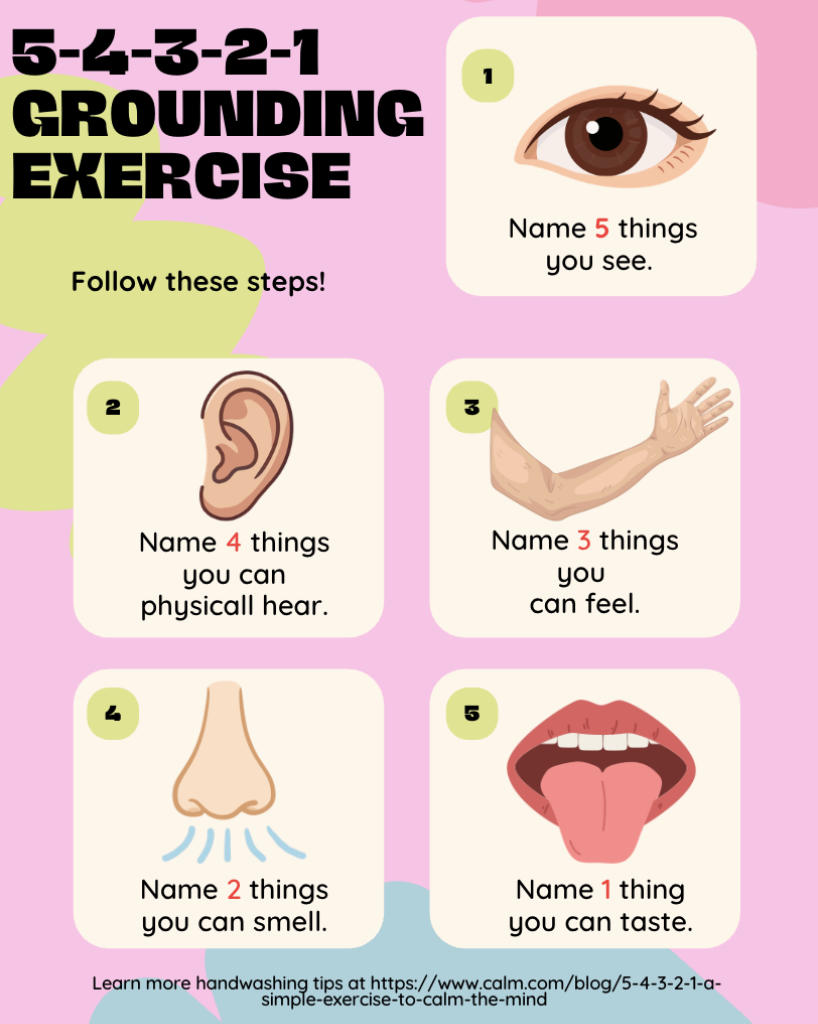
The 5-4-3-2-1 Grounding Exercise
We know your brain is probably a total mess right now. You’re staring up at the ceiling, and your mind is aggressively looping the exact same terrifying thoughts over and over.
When your brain is spinning at a million miles an hour, telling yourself to “just stop worrying” or “just calm down” is completely useless. But what you can do is use your five physical senses to hijack your nervous system and pull your brain back down to earth before you try to sleep.
Right before you turn off the lights tonight, try this quick, 5-step grounding hack. It’s a biological circuit-breaker that forces your mind to lock it back into yourself. Find a comfortable spot—whether you’re lying in bed, sitting up, or just standing by the door—and map out your space using the steps below.