
Skip to content

Guide 3- Understanding Treatment

Because being there is already enough. 

Save this guide to revisit anytime, no need for internet access or page scrolling

Introduction

Who is this guide for?

This guide is for teen siblings* of children with cancer or other serious illnesses** who want to learn how to start or navigate sensitive conversations about processing the diagnosis at an early stage. If you’re involved in the care or well-being of your sibling with cancer or other serious illnesses—or anticipate you will be in the future—you’re in the right place. We’re here to give you actual, practical tools to help you find your footing, talk about the hard stuff when you’re ready, and process all of this at your own pace.

*Throughout this guide, the term teen siblings refers to siblings, siblings-in-law, cousins, and other extended family members or young caregivers between the ages 13~18.

**The term “other serious illnesses” refers to any severe, life-changing health condition—including complex chronic diseases, severe genetic disorders, major heart conditions, or sudden traumatic injuries. 

About this guide

This guide was developed entirely by Sibling Society. While we’ve made every effort to ensure the information in this guide is accurate and up to date, it should be noted this resource is not a substitute for professional advice. Note that the insights and coping strategies outlined in this guide are grounded in the real, lived experiences of siblings whose brothers or sisters had serious illnesses within their own families. They are intended for peer-support and educational purposes only. 

We are always looking to improve our resources to better support our community. Should you have any suggestions, edits, or feedback regarding this guide, please email us at siblingsociety2024@gmail.com

Sibling Society

Founded by a sibling whose younger sister was diagnosed with leukemia, Sibling Society is a registered nonprofit organization in Ontario dedicated to supporting, empowering, and informing siblings of children with cancer, so they can move forward in their changing role with confidence and strength. We provide peer support counseling, mentorship programs, and community events to help siblings process their feelings and experiences by forming a deeply connected community. Visit siblingsociety.org for more information.

How Will My Sibling Be Treated?

Treatment aims to help your brother or sister get better, manage symptoms, or stop an illness from getting worse. The type of treatment they receive depends on things like:

  • Their illness or diagnosis
  • How serious the illness is and how it affects their body
  • Their age and overall health
  • Their medical history
  • Whether the illness is newly diagnosed, ongoing, has returned, or is experiencing a flare-up

Every illness is different. Even if two children have the same diagnosis, they may not receive the exact same treatment or respond to treatment in the same way. Doctors create a treatment plan based on what they believe will work best for each child. To decide the plan, the doctors will do different monitoring tests. See Appendix – Chart A for more information. 


What Are Treatment Side Effects?

Side effects can happen because treatments affect the body in different ways while helping to fight an illness or manage symptoms. Some side effects may include:

  • Feeling tired or needing more rest
  • Feeling sick to the stomach or having trouble eating
  • Pain or discomfort
  • Changes in appearance, such as hair loss, swelling, scars, or weight changes
  • Difficulty sleeping
  • Mood changes, frustration, sadness, or worry
  • Having less energy for activities they usually enjoy

Some side effects go away soon after treatment, while others may last longer or come and go over time. Write down what other side effects your brother or sister might be experiencing below!

Want to learn more about different types of treatment & their corresponding side effects? See Appendix – Chart B for more information.

Things to Keep in Mind During Treatment

Some illnesses or treatments can make it harder for your brother or sister’s body to fight infections. They may also need extra rest or have special instructions from their healthcare team. Because of this, you may need to:

  • Wash your hands often to help stop germs from spreading.
  • Tell a parent or caregiver if you have been around someone who is sick.
  • Stay away from your sibling if you are feeling unwell.
  • Follow any hospital or home-care rules your family has been given.

These precautions can help keep your sibling as healthy and safe as possible.

Waiting For the Answer

Waiting to see how treatment will work can be really hard. Some days your brother or sister may seem much better, and other days they may feel tired, uncomfortable, or need more support. Doctors may try different treatments, adjust medications, or change parts of the treatment plan over time. Treatment and recovery can last weeks, months, or sometimes years. Living with uncertainty can feel like an emotional roller coaster for everyone in the family. During this time, remember that your sibling’s healthcare team is working hard to help them feel better and improve their quality of life. See Appendix – Chart C for more information on the medical staff you might meet.

Asking Questions

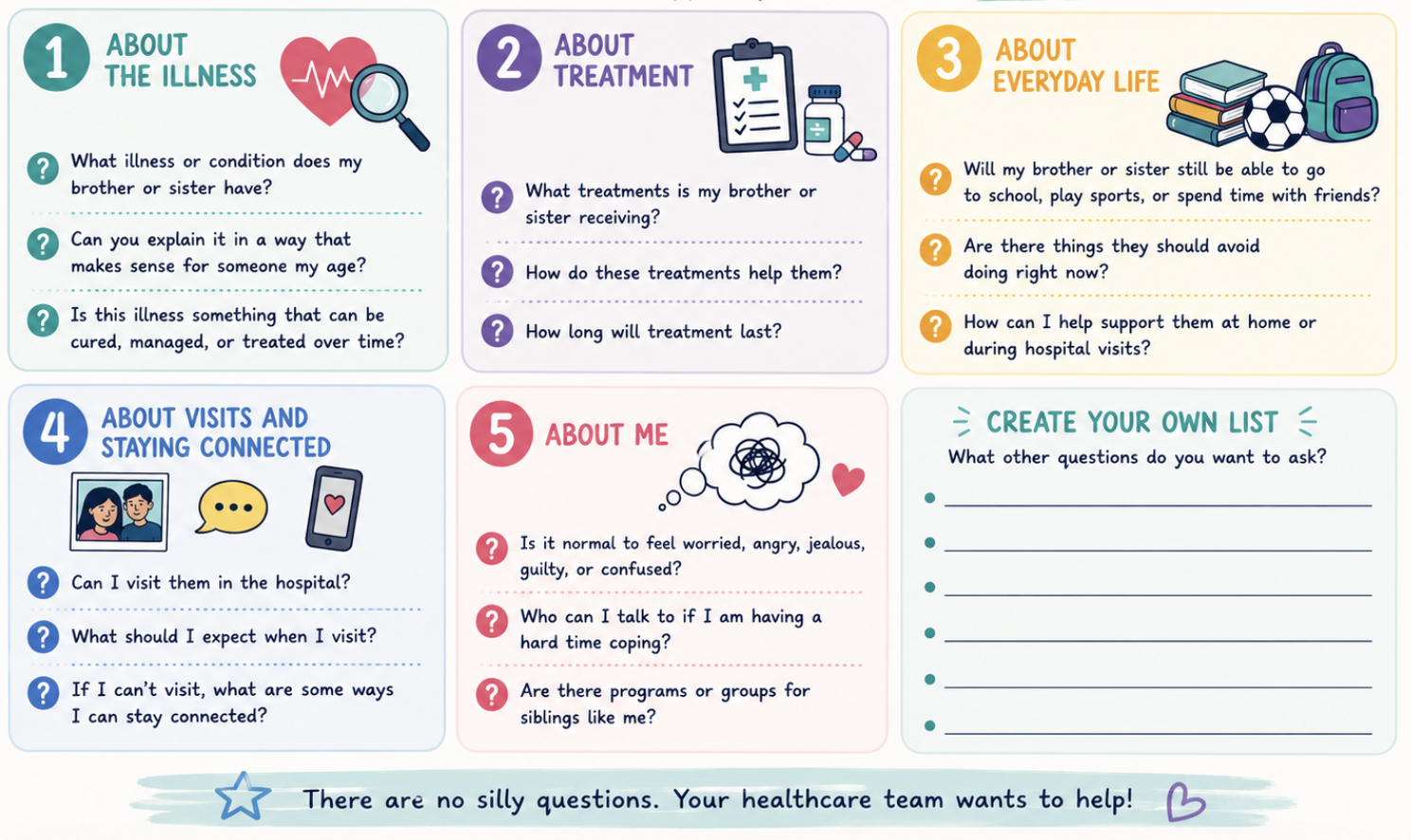
It is okay to have questions, worries, or mixed emotions while you wait. Asking questions can help you better understand what is happening and feel more included in your sibling’s care journey.

You may want to ask a doctor, nurse, social worker, child life specialist, or another member of your sibling’s healthcare team. Below is a sample list of questions. Create your list of questions too!

Want to Visit?

Some illnesses or treatments can make it harder for your brother or sister’s body to fight infections. They may also need extra rest or have special instructions from their healthcare team. Because of this, you may need to:

  • Wash your hands often to help stop germs from spreading.
  • Tell a parent or caregiver if you have been around someone who is sick.
  • Stay away from your sibling if you are feeling unwell.
  • Follow any hospital or home-care rules your family has been given.

These precautions can help keep your sibling as healthy and safe as possible.

Close to Home

If your brother or sister is staying in a hospital or receiving treatment nearby, you may be able to visit.

Find out ahead of time how they are doing and what to expect. You might read together, draw, play games, watch a movie, or simply sit and talk. Some teens also want to help care for their siblings. If you’re interested, ask a nurse or another healthcare professional what you can do.

Sometimes seeing your sibling in a hospital bed or connected to medical equipment can be upsetting. Many siblings say they are still glad they visited because it helped them feel connected and spend time together.

Far From Home

Sometimes treatment happens far from home, and you may not be able to visit as often.

It can help to stay in touch by talking on the phone, video chatting, sending cards or drawings, sharing photos, or playing games online together. Even small ways of staying connected can remind your sibling that you’re thinking about them.

Appendix

Chart A - Monitoring Test1

Below is a list of tests that help the healthcare team check how your brother or sister is going and guide their treatment.

Common Tests What They Show
Blood Tests Check blood counts, organ function, infection, and whether the balance of the cells and chemicals is normal.
Biopsy A small sample of tissue is taken and examined to see if it contains cancer cells, what type of cells they are, and how aggressive the illness might be.
CAT scan or CT scan (Computerized Axial Tomography) Uses x-rays and a computer to produce three-dimensional (3-D) images of the body inside.
Heart Tests (EKG, echocardiogram) Check how the heart is working—its rhythm, strength, and structure—especially to see if treatments like chemotherapy are affecting the heart.
Lumbar Puncture (LP) Checks the fluid around the brain and spinal cord to see if there are cancer cells, infections, or other changes.
MRI (Magnetic Resonance Imaging) Uses magnets and radio waves to create very detailed images of soft tissues like the brain, spine, and organs.
PET (Positron Emission Tomography) Shows how active cells are in the body. It can help detect cancer activity or see if treatment is working.

1. Canadian Cancer Society. “Tests and Procedures.” Cancer.ca. Accessed 2026. https://cancer.ca/en/treatments/tests-and-procedures.

 Chart B – Different Treatment Plans & Their Side Effects2

Treatment How It Helps Possible Side Effects
Chemotherapy Uses strong medicine to kill bad cells or stop them from growing throughout the body. Tiredness, nausea/vomiting, hair loss, higher risk of infections, loss of appetite, mouth sores, feeling weak or “not themselves.”
Immunotherapy Helps the body’s immune system recognize & fight bad cells more effectively. Flu-like symptoms (fever, chills, tiredness), skin reactions, stomach issues.
Radiation therapy Uses focused energy beams to shrink or destroy cells in a specific area of the body. Skin irritation, tiredness, hair loss in the treated area, nausea depending on where treatment is given.
Rehabilitations (physio, occupational therapy, counselling, speech therapy) Helps rebuild strength, daily skills, communication, and emotional health during or after treatment. Can be tiring or frustrating, slow progress, soreness after exercises, emotional stress during adjustment.
Stem cell or organ transplant Replaced damaged cells or organs with healthy ones to help the body rebuild after illness or intensive treatment. Long recovery, high infection risk, fatigue, nausea, mouth sores, emotional ups and downs, hospital stays.
Steroids Help reduce swelling, ease symptoms quickly, and sometimes make other treatments work better. Mood swings, increased appetite, weight gain, trouble sleeping, restlessness, emotional changes.
Surgery Remove affected areas of the body. Pain during recovery, tiredness, infection risk.

2. National Cancer Institute. “Side Effects of Cancer Treatment.” Cancer.gov. Accessed 2026. https://www.cancer.gov/about-cancer/treatment/side-effects.

 Chart C – Healthcare Professionals / Team3

Doctor

Doctor (Physician)

Leads the medical care, makes treatment plans, and checks how your sibling is doing.

Nurse

Nurse

Provides day-to-day medical care, checks symptoms (pain or fever), answers questions. Nurses are often the people families see the most.

Pharmacist

Pharmacist

Prepares and gives out medications, makes sure doses are safe, and explains how each medicine works and possible side effects. They also check for medication interactions.

Social Worker

Social Worker

Supports the emotional side of cancer and illness. Helps families cope, connects them to financial or housing resources, and provides counselling or support services.

Child Life Specialist

Child Life Specialist

Helps kids understand what’s happening in a simple, less scary way. Uses play, art, and education to prepare them for tests or treatments and reduce fear and stress.

Therapists

Therapists

Help with recovery and daily life skills. This can include rebuilding strength and movement, helping with everyday tasks like eating or writing, improving speech, or supporting emotional well-being.

3. SickKids Hospital. “Your Healthcare Team.” AboutKidsHealth.ca. Accessed 2025. https://www.aboutkidshealth.ca.