Guide 4- Taking Care of Yourself
You do not have to go through this alone.

Save this guide to revisit anytime, no need for internet access or page scrolling
Introduction
Who is this guide for?
This guide is for teen siblings* of children with cancer or other serious illnesses** who want to learn how to start or navigate sensitive conversations about processing the diagnosis at an early stage. If you’re involved in the care or well-being of your sibling with cancer or other serious illnesses—or anticipate you will be in the future—you’re in the right place. We’re here to give you actual, practical tools to help you find your footing, talk about the hard stuff when you’re ready, and process all of this at your own pace.
*Throughout this guide, the term teen siblings refers to siblings, siblings-in-law, cousins, and other extended family members or young caregivers between the ages 13~18.
**While a lot of this guide focuses on cancer, the term “other serious illnesses” refers to any severe, life-changing health condition—including complex chronic diseases, severe genetic disorders, major heart conditions, or sudden traumatic injuries.
About this guide
This guide was developed entirely by Sibling Society. While we’ve made every effort to ensure the information in this guide is accurate and up to date, it should be noted this resource is not a substitute for professional advice. Note that the insights and coping strategies outlined in this guide are grounded in the real, lived experiences of siblings whose brothers or sisters had serious illnesses within their own families. They are intended for peer-support and educational purposes only.
We are always looking to improve our resources to better support our community. Should you have any suggestions, edits, or feedback regarding this guide, please email us at siblingsociety2024@gmail.com
Sibling Society
Founded by a sibling whose younger sister was diagnosed with leukemia, Sibling Society is a registered nonprofit organization in Ontario dedicated to supporting, empowering, and informing siblings of children with cancer, so they can move forward in their changing role with confidence and strength. We provide peer support counseling, mentorship programs, and community events to help siblings process their feelings and experiences by forming a deeply connected community. Visit siblingsociety.org for more information.
Taking Care of Your Body and Mind
When we are stressed or worried, our bodies feel it too. Taking care of yourself is not selfish—it actually helps you show up better for your family. Even small actions can make a big difference to your body and mind.
Things that can help
| Physical Self-Care | Emotional Self-Care |
|---|---|
| Getting enough sleep (7~9 hours) | Journaling your thoughts |
| Eating regular meals | Listening to music that fits your mood |
| Moving your body — walk, dance, stretch | Breathing slowly when overwhelmed |
| Spending time outdoors | Watching or reading comic books |
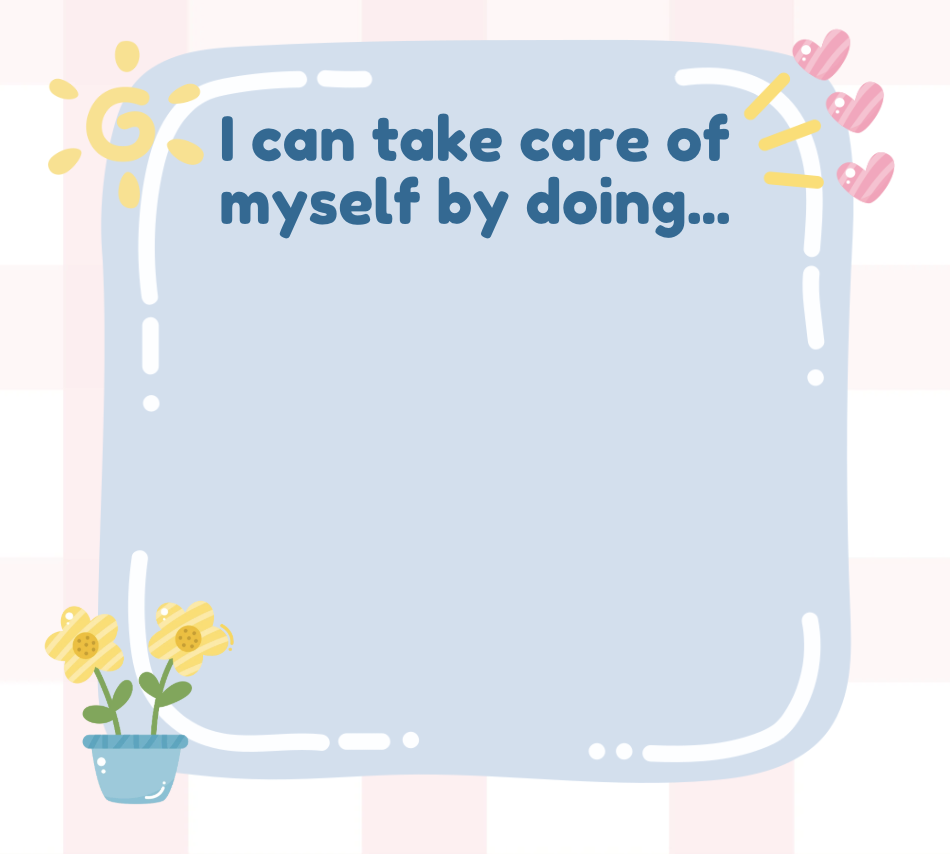
List down other things that you find helpful physically and emotionally!
Sometimes the weight of everything can become overwhelming. Below are some signs that you may need to see a counselor.
If you checked any of those boxes above, it’s important to talk to a trusted adult or a counsellor.
See appendix – Chart A for different resources when asking for professional help.
Finding Support
You do not have to go through this alone. There are many people and places that can offer support—you just have to know where to look. Don’t be shy about asking for help!
Here are some tips and steps when you are talking with your parents about this.
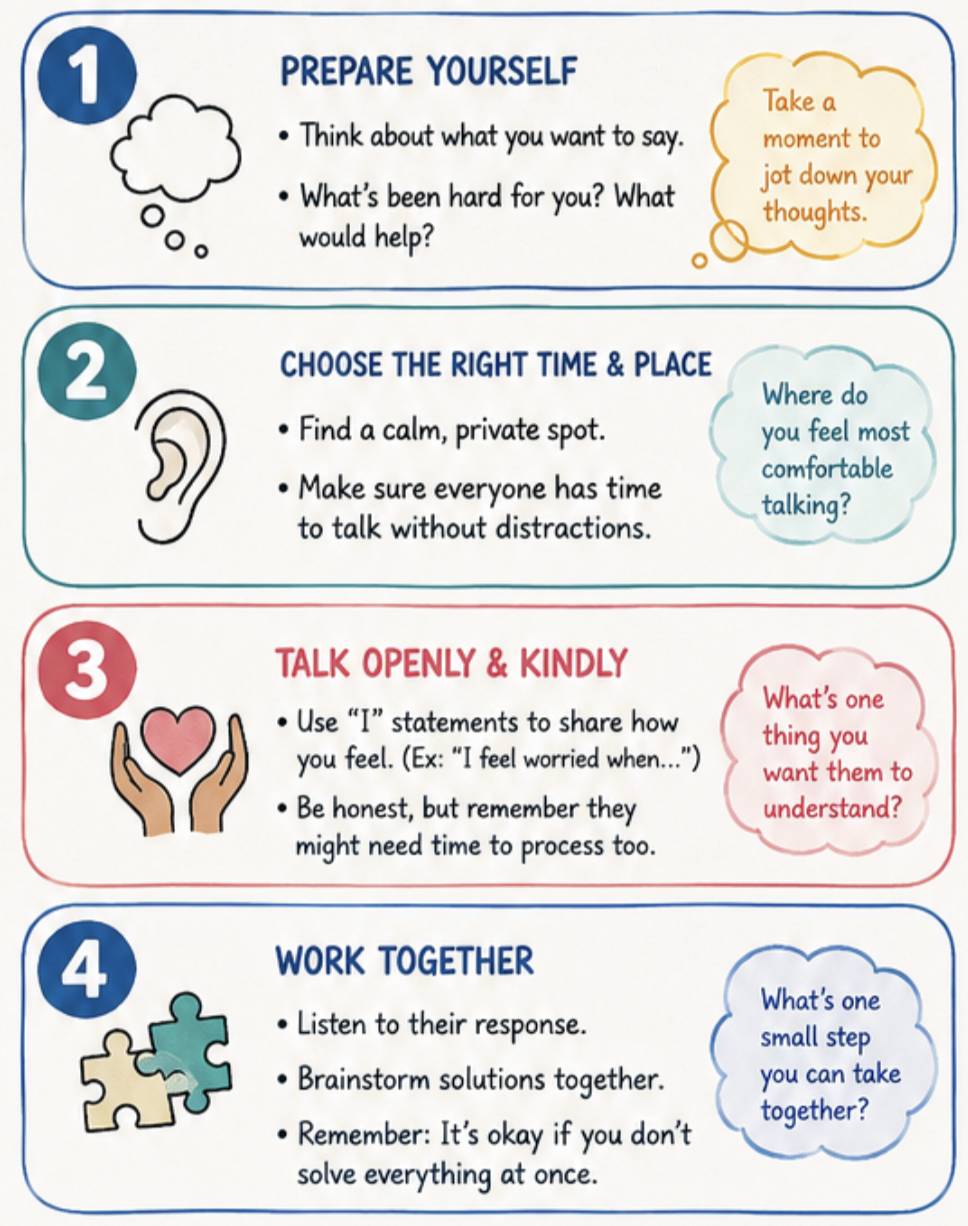
Sometimes talking to your parents is not enough. When you are having a hard time, it can be helpful to talk to a counselor.
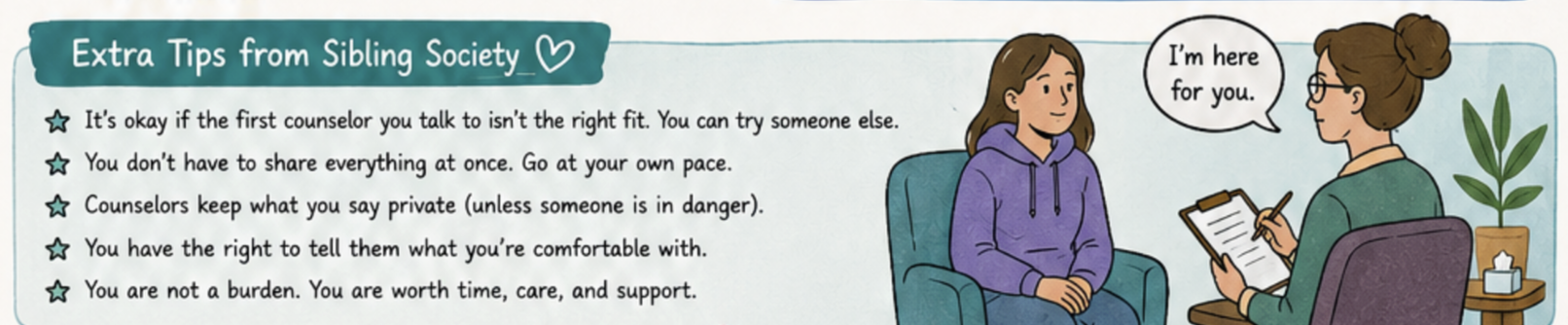
Talking to a counselor doesn’t mean something is “wrong” with you and it definitely doesn’t mean you are mentally ill. It means you are taking care of yourself. Everyone—athletes, celebrities, students, even adults—turns to counselors when life gets tough. Reaching out is a sign of strength, not a weakness.
Speaking with a counselor has the similar four steps compared with talking to your parents or guardians, but here are a few tips from us when it comes to talking with a professional like a counselor:
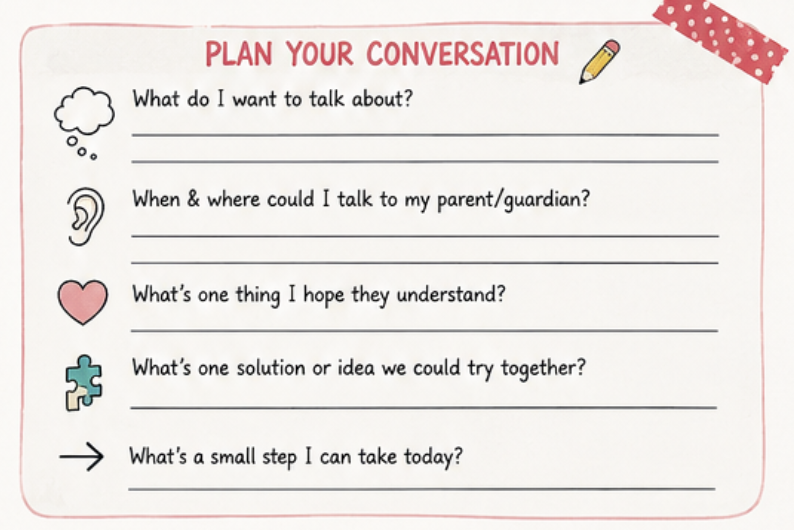
Whoever you feel like talking to, go ahead and plan your conversation below!
You and Your Friends
Deciding what to tell your friends—and how much—is completely up to you, there’s no right or wrong way. Some teens find that talking about it brings them closer to their friends. Others prefer to keep some parts private. Both are okay.
If You Want to Tell Them
You don’t need to share every medical detail. You can start simple:
- “My brother (sister) has been really sick lately and things at home are hard.”
- “I’m going through a tough time—I might need a little extra support.”
- “I can’t always hang out right now but I still want to stay in touch with you guys.”
Consider the following scenarios when you tell your friends about your sibling:
| How they might react | You could say… |
|---|---|
| They ask lots of tough questions about what your sibling is going through. | "Thanks for asking about my family and me. Here's what I feel comfortable sharing: [ADD IN YOUR OWN INFORMATION HERE]" |
| They stop inviting you for hangouts because they think you're too busy. | "I miss hanging out together. I know that I've had a lot on my mind since my sister got sick. Want to hang out tomorrow?" |
| They say something unhelpful or insensitive. | "I know you were trying to help, but that comment was hard for me to hear. What helps most is just having someone who listens." |
| They say mean things, making jokes about your sibling's illness. | "Hey, my brother/sister has [illness name]. It's not funny. How would you feel if it were your brother/sister?" |
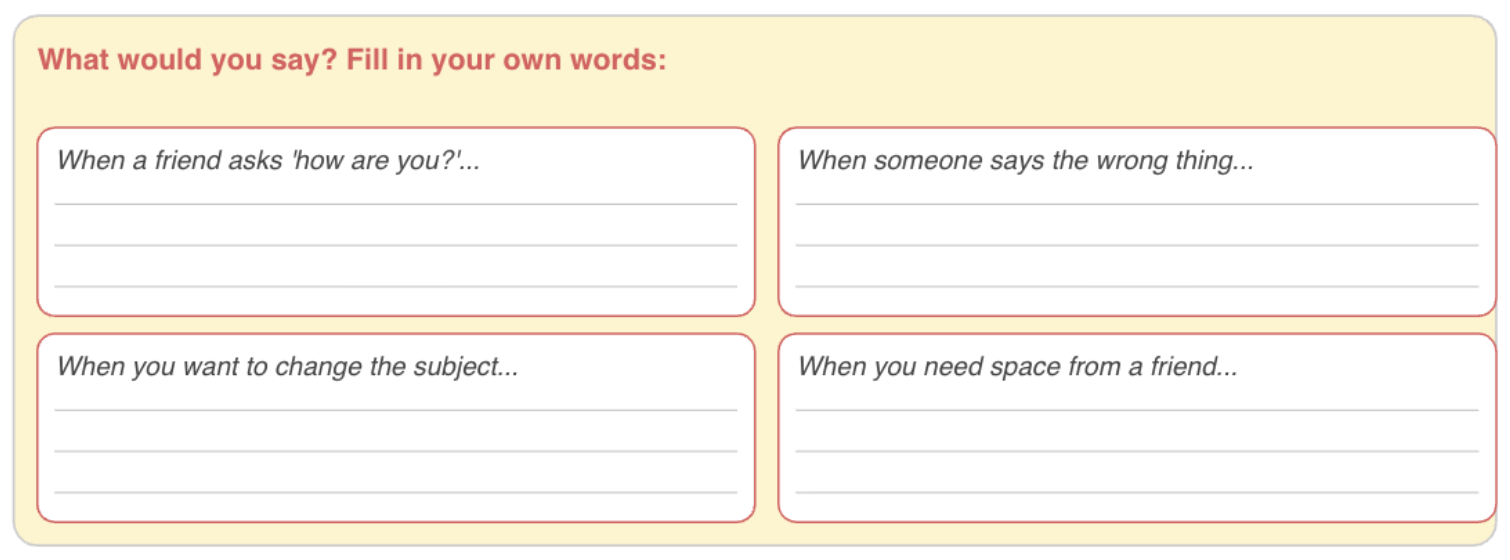
Writing out where you’d say can help you feel more prepared when the comment comes.
Appendix
Chart A - Support Resources for Teen Siblings
| Resource | What it Offers | How to Access |
|---|---|---|
| Kids Help Phone (Canada) | Free, confidential counselling by phone or text, 24/7 | Call 1-800-668-6868 or text HELLO to 686868 |
| Wellspring Cancer Support | Free community programs for families affected by cancer | Visit wellspring.ca |
| Campfire Circle | Free seasonal camp programs for siblings aged 6~15 of children affected by cancer. The most recent one is August 21~27, 2026 in Muskoka. | Visit https://campfirecircle.org/ to join as a new family! |
| Sibling Society Peer Mentorship Program | Paired-up one-on-one support from a teen sibling who has lived a similar experience. | Sign up here or visit our website siblingsociety.org for detailed information |