Guide 5- Roads Ahead
Learn about next steps and feel prepared.

Save this guide to revisit anytime, no need for internet access or page scrolling
Introduction
Who is this guide for?
This guide is for teen siblings* of children with cancer or other serious illnesses** who want to learn how to start or navigate sensitive conversations about processing the diagnosis at an early stage. If you’re involved in the care or well-being of your sibling with cancer or other serious illnesses—or anticipate you will be in the future—you’re in the right place. We’re here to give you actual, practical tools to help you find your footing, talk about the hard stuff when you’re ready, and process all of this at your own pace.
*Throughout this guide, the term teen siblings refers to siblings, siblings-in-law, cousins, and other extended family members or young caregivers between the ages 13~18.
**While a lot of this guide focuses on cancer, the term “other serious illnesses” refers to any severe, life-changing health condition—including complex chronic diseases, severe genetic disorders, major heart conditions, or sudden traumatic injuries.
About this guide
This guide was developed entirely by Sibling Society. While we’ve made every effort to ensure the information in this guide is accurate and up to date, it should be noted this resource is not a substitute for professional advice. Note that the insights and coping strategies outlined in this guide are grounded in the real, lived experiences of siblings whose brothers or sisters had serious illnesses within their own families. They are intended for peer-support and educational purposes only.
We are always looking to improve our resources to better support our community. Should you have any suggestions, edits, or feedback regarding this guide, please email us at siblingsociety2024@gmail.com
Sibling Society
Founded by a sibling whose younger sister was diagnosed with leukemia, Sibling Society is a registered nonprofit organization in Ontario dedicated to supporting, empowering, and informing siblings of children with cancer, so they can move forward in their changing role with confidence and strength. We provide peer support counseling, mentorship programs, and community events to help siblings process their feelings and experiences by forming a deeply connected community. Visit siblingsociety.org for more information.
When Treatment Ends
The end of treatment is a big milestone. It can feel like a finish line—and in many ways, it is. But it can also feel complicated.
What You Might Be Feeling
| Feeling | Why It Makes Sense |
|---|---|
| Relief | The hardest part is over—or at least a big part of it. |
| Worry | What if it comes back? Will my sibling still be sick? |
| Awkwardness | Not knowing how to act now that things are "different". |
| Grief | Processing everything you and your family went through. |
| Confusion | Not sure how to 'go back to normal' or what normal even means now. |
All these feelings are normal. Things may not go back to exactly how they were before the illness came into your lives. Getting back to your “old life” may take a long time—and it may not happen as you expect.
What If Treatment Doesn’t Help?
You and your family will face even more challenges. Hearing that your sibling might die is very, very difficult. You may feel many of the same emotions you felt when you first learned that your brother or sister is sick.
No booklet or guide can give you all the answers or tell you exactly how you will feel. But when the future is so uncertain, it helps to:
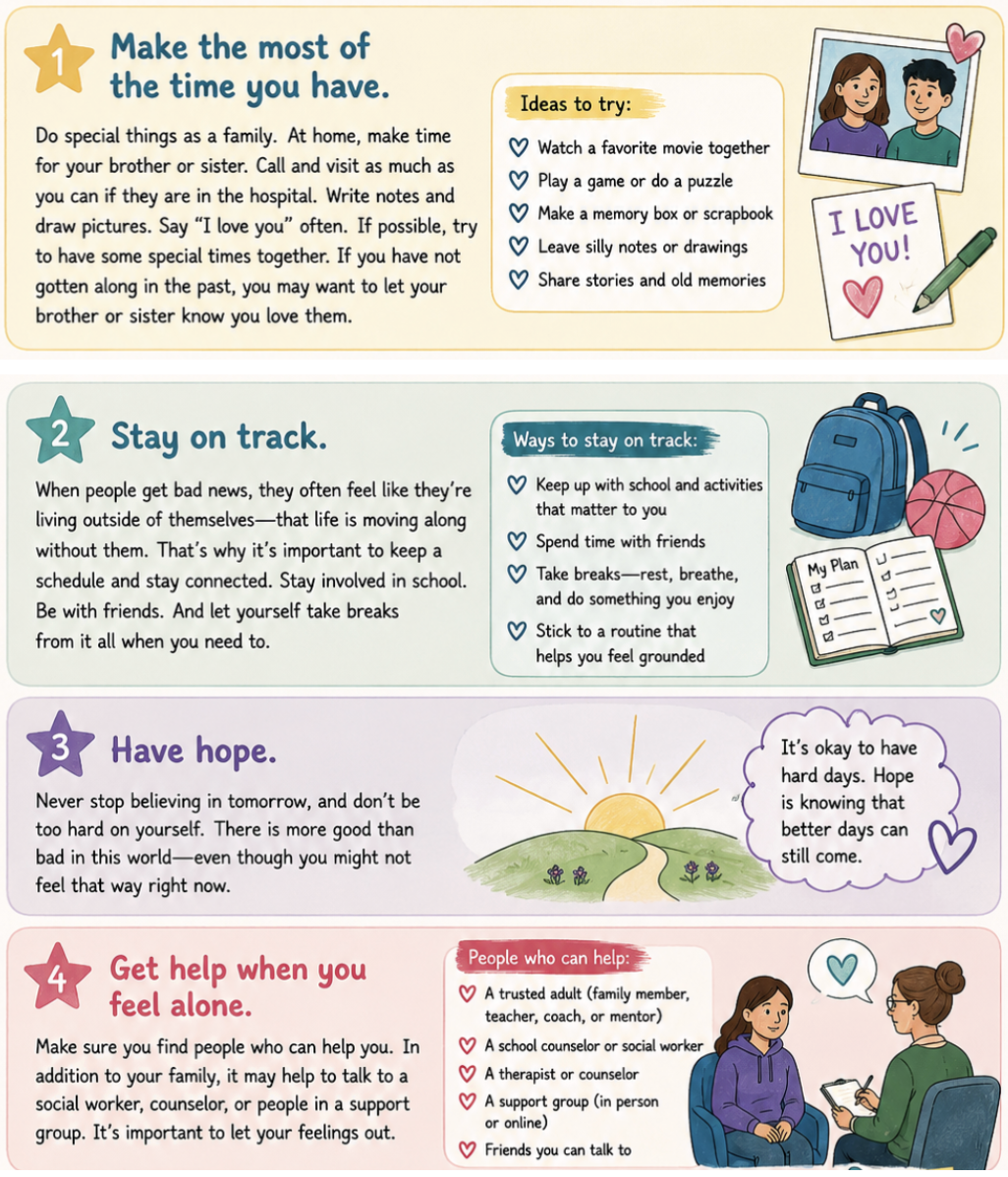
If Your Brother or Sister Passes Away, Know That:
→ You’ll always have memories.
Your brother or sister will always be part of your life. Hold on to your memories of the good times. It’s okay to think about something funny that your brother or sister did or said. By laughing and smiling you are bringing back just a little of what was so special about them.
→ The pain will lessen with time.
At first the pain may be so strong that you might wonder whether you will ever feel happy again. Time has a way of healing. Not being sad every day doesn’t mean that you have forgotten. It just means you’re starting to heal.
→ Your sibling would want you to be happy.
Stay open to new experiences. Make small changes that give your life new meaning. Write about your thoughts and about this experience. Don’t worry about what to say, just write.
The Roads Ahead
After treatment ends, there are several possible roads ahead. No one knows exactly which path your family will take—but knowing what might happen can help you feel more prepared.
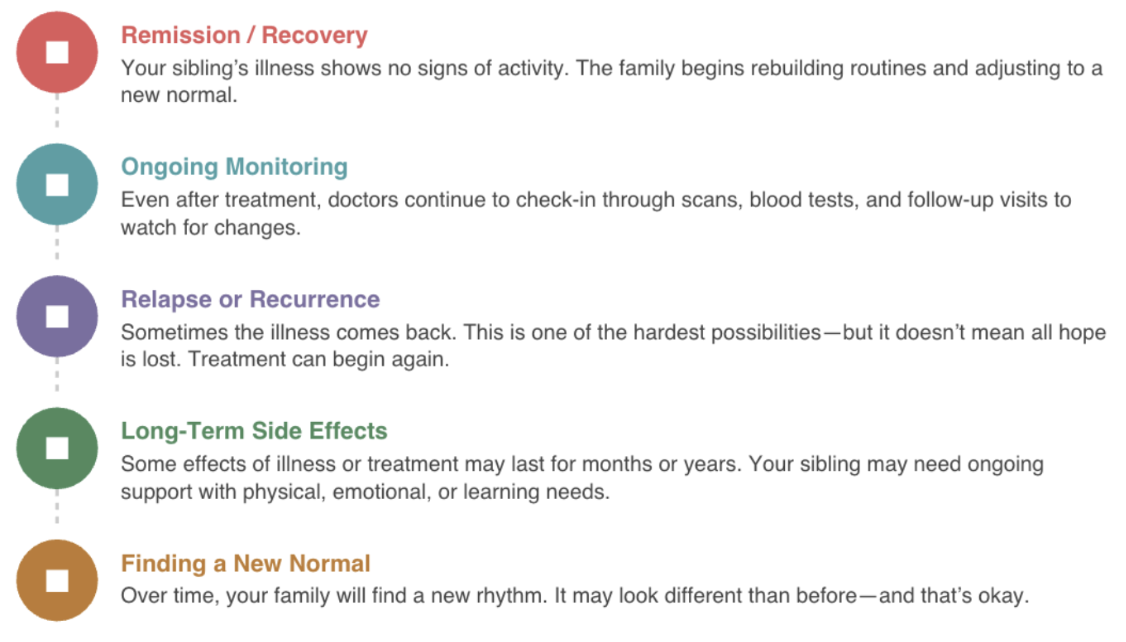
Post-Treatment Cautions
Even after active treatment ends, your brother or sister’s body may still be recovering. The healthcare team will share specific instructions—but there are some general things to be aware of as a family.
| Physical Recovery | Emotional Recovery |
|---|---|
|
|
Helping Your Sibling Go Back to School
Returning to school after a serious illness can be one of the most exciting—and overwhelming—steps in recovery. Your sibling may feel nervous, behind, or unsure of where they fit now. You can be a huge part of making that transition easier.
| Academic Support | Social Support |
|---|---|
|
|
As a sibling, you might meet the following scenarios when your sick sibling returns to school.
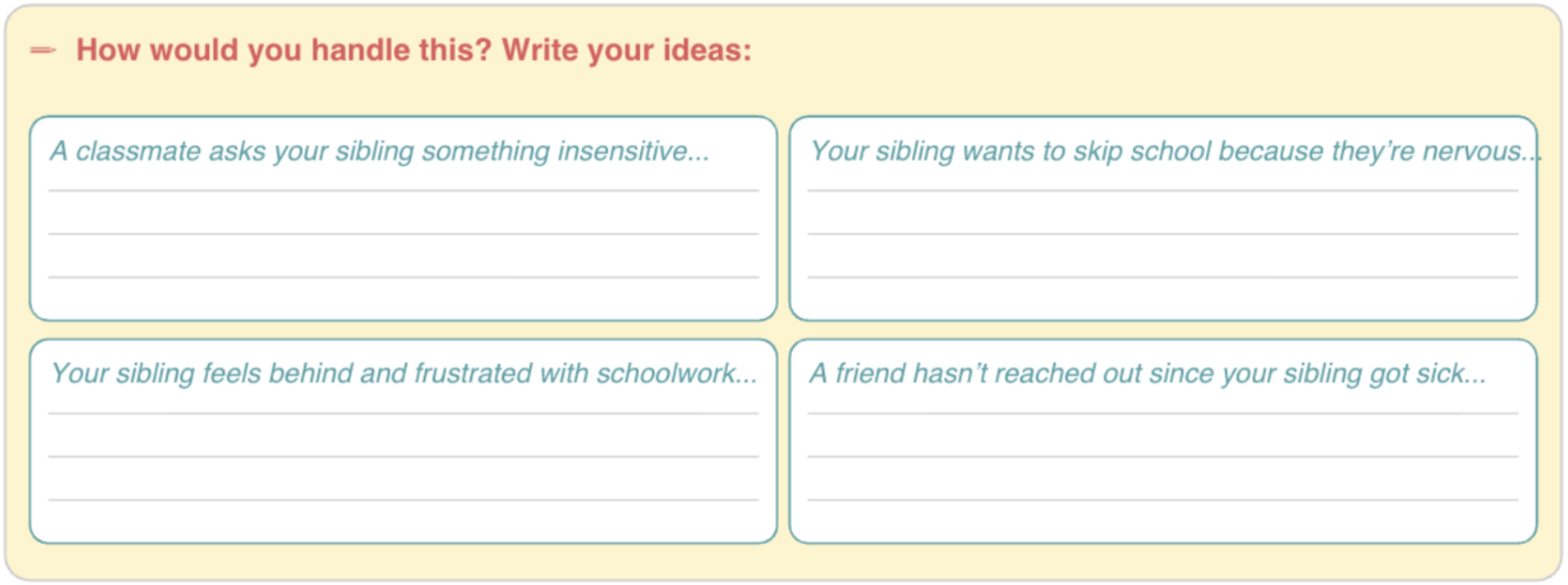
Helping Your Sibling Talk to Friends
Your sibling may not know what to say about what they’ve been through. Some friends will be warm and welcoming. Others might be awkward, distant, or ask questions your sibling isn’t ready to answer. Here are some ways you can help.
Starter Scripts Your Sibling Can Use
→ “I’ve been going through some health stuff, but I’m doing better now!”
→ “I’m still figuring things out, but it’s great to be back.”
→ “I’d rather not talk about all the details, but I’m okay.”
→ “If you want to help, just treat me normally.”
What You Can Do as Their Sibling
→ Be a buffer in social situations where your sibling feels unsure
→ Let them set the pace—don’t push them to talk about the illness to their friends if they’re not ready
→ Speak up if you see a friend treating them differently or being unkind
→ Celebrate the small moments: their first day back, their first lunch with friends, a test they passed